Left-right symmetry#
A mirrored sample must remain physically consistent: depth, terrain heights,
motion commands, robot state and actions all describe the same reflection.
The -Symmetry tasks apply these transforms together during learning.
Depth: reflect the camera image#
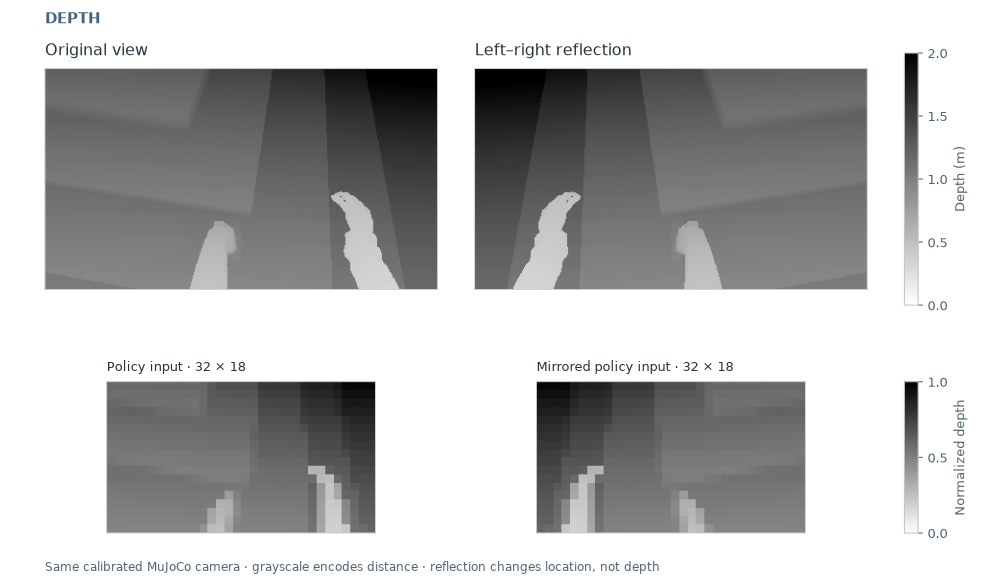
Simulated head-camera depth and its left-right reflection. The upper views show the scene at higher resolution; the lower views show the 32 × 18 policy input. Bright pixels are nearer. Both columns use the same scale.#
The default head-camera tensor has shape (B, 1, 18, 32). Reflection reverses its width
axis while preserving row order and depth values:
mirrored_depth = depth.flip(-1)
Equivalently, \(D^{\mathrm{mirror}}_{v,u}=D_{v,W-1-u}\). The transform acts after normalization and crop/resize. The high-resolution view above is for reading the scene; it does not change the policy’s input resolution.
The optional upstream pinhole and rendered baselines retain body-aligned cameras
looking along local -Z. For these configurations, lateral body y is the image
height axis, so their sagittal transform and debug preview use depth.flip(-2).
This differs from the default head-camera calibration. Arbitrary camera mounting
rotations require a corresponding review of the image symmetry transform.
Elevation: reflect lateral position#
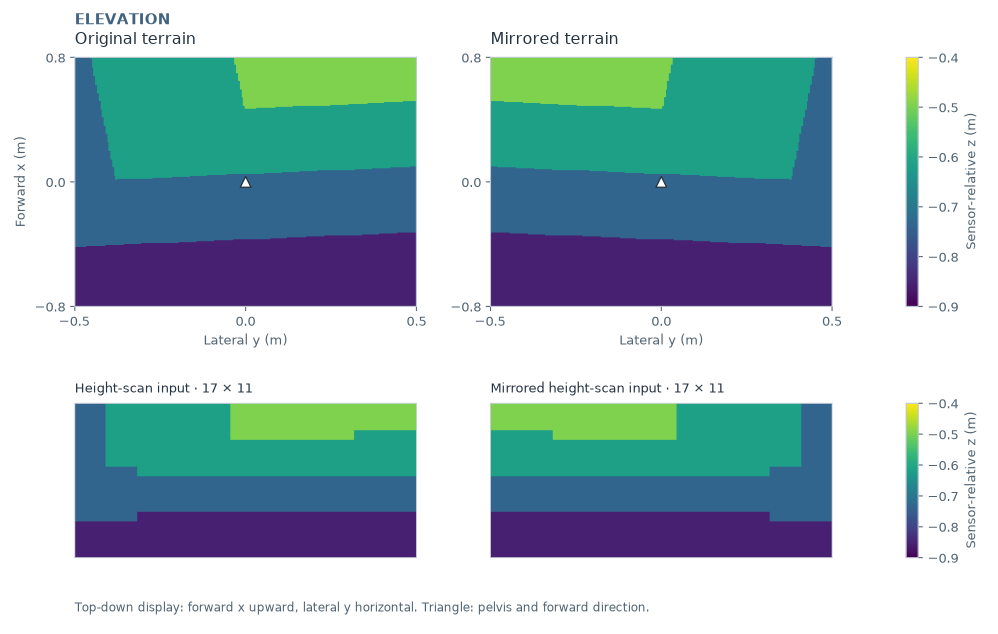
Terrain heights from the same pose. Color encodes sensor-relative z, and the triangle marks the pelvis and forward direction. The upper maps sample the geometry densely for display; the lower maps show the 187 samples used by the observation.#
The height scan uses a yaw-aligned frame: x points forward, y is lateral,
and z points up. Its 1.6 m × 1.0 m footprint at 0.1 m spacing gives
Nx = 17 and Ny = 11. Values are flattened from a (Ny, Nx) grid.
Restore that layout, reverse lateral y, then flatten again:
grid = elevation.reshape(-1, 11, 17)  # batch, lateral y, forward x
mirrored_elevation = grid.flip(-2).flatten(start_dim=1)
This is \(H^{\mathrm{mirror}}_{i_y,i_x}=H_{N_y-1-i_y,i_x}\): forward position and
height remain unchanged. Current height observations are clipped to
[-1.5, 0.0] m relative to the sensor.
The plots display grid.T so forward x points upward. Their horizontal mirror
is therefore a reversal of the stored lateral axis, not the stored last
axis. Flipping the flattened vector end-to-end would also reverse forward x
and is a different operation.
Reflect the full observation#
Image mirroring alone would leave the rest of a training sample inconsistent. The same reflection also acts on commands, state and joint actions:
Quantity |
Reflection |
|---|---|
Position and linear velocity |
|
Angular velocity |
|
Joints and joint actions |
Exchange left/right joints and apply their joint-axis signs |
Bodies and contact channels |
Exchange left/right counterparts |
The group transforms check observation widths and processed camera shape against the configured layout. No mirrored motion files need to be stored on disk.
PPO and distillation#
PPO uses mirror consistency. The additional loss encourages the action on a mirrored observation to match the mirrored action on the original observation. The supplied PPO configurations enable that loss and leave rollout data augmentation disabled.
Distillation uses teacher supervision on augmented observations. The frozen
teacher is queried again on the original-plus-mirrored observations; its targets
are not produced by simply reflecting an earlier action. This does not assume
the teacher is already perfectly symmetric. symmetry_bc_coef weights the
additional supervised loss and defaults to 1.0.
Remove -Symmetry from a task ID to select its configuration without these
terms. The transforms live in tasks/perceptive/mdp/symmetry_terms.py and
utils/symmetry.py under src/perceptive_bfm/.